How long does it take to paint a house?
Realistic UK timings for single rooms, whole-home repaints, exteriors and kitchen sprays — with the factors that genuinely change the schedule.
Jump to a section
“How long will it take?” is one of the first three questions every homeowner asks — and the honest answer is “it depends”. Project size, condition of the walls, whether you’re including ceilings and trim, the time of year and whether scaffolding is needed all swing the timeline. This guide gives you realistic UK ranges for each common project type, the factors that genuinely change the schedule, and the questions to ask any painter quoting your job.
Quick timing comparison
These are typical timings for jobs done by an experienced two-person crew with proper preparation. Cheap quotes that promise much faster timings usually skip the prep that makes a finish last.
| Project | Typical timing | Main drivers |
|---|---|---|
| Single room | 1–3 days | Room size, ceilings, trim, wall condition |
| Hallway, stairs & landing | 2–4 days | Access, height, banister detail |
| Whole 2-bed flat (interior) | 4–7 days | Coat count, woodwork, snags |
| Whole 3-bed house (interior) | 5–10 days | Furniture, schedule around family life |
| Whole 4–5 bed house (interior) | 10–15 days | Multiple crews vs single crew |
| Exterior (terraced/semi) | 5–8 days | Weather windows, prep, access |
| Exterior (detached / gable end) | 10–12 days | Scaffolding, substrate repair |
| Kitchen cabinet respray | 3–7 days | Door count, shaker vs slab, drying |
| Feature wall (wallpaper) | 1 day | Pattern repeat, lining prep |
| Full room wallpaper | 2–3 days | Wall condition, pattern matching |
Pro tip: ask any painter for a written, phased schedule — not a vague start date. A proper quote breaks the job into prep, primer, first topcoat and second topcoat across specific days. If they can’t tell you what happens on day 3, the price they’ve quoted is a guess.
How long does it take to paint a single room?
A standard bedroom in good condition takes 1–2 days. A larger living room with detailed trim, ceiling work, or wallpaper removal moves toward 2–3 days. Here’s where the time actually goes:
- Day 1 morning — prep: furniture moved and covered, floors dust-sheeted, sockets and trim masked, walls cleaned, any cracks filled and sanded smooth. This is usually 2–3 hours and it’s the step that decides whether the finish lasts.
- Day 1 afternoon — first coat: ceiling first (if included), then walls, then trim. Most modern water-based paints touch-dry within 1–2 hours.
- Day 2 morning — second coat: once the first coat is fully dry, the second top coat is applied. Cutting-in around skirting, sockets and corners is the slow part — not the rolling.
- Day 2 afternoon — touch-ups, walkthrough, clean down.
For a feature wall only, with no ceiling and no trim, a careful 1-day job is realistic. For a kitchen-diner with high ceilings, mouldings or coving, 3 days is more honest. See our interior painting service for room-by-room pricing.
How long does it take to paint a whole house (interior)?
A typical 3-bedroom UK house takes 5–10 working days. Two crew members can work two rooms at once when paint is curing in one of them, which is how an experienced team keeps momentum. Here’s a realistic breakdown for a 3-bed:
- Day 1: walk-through with the homeowner, agree colour cards and protection plan, move and cover furniture, mask floors.
- Days 2–4: downstairs rooms — living room, dining room, kitchen-diner. Two coats per wall plus ceilings and trim.
- Days 5–6: hallway, stairs and landing. Awkward access usually means these take longer per square metre than the rooms.
- Days 7–9: bedrooms and bathroom. Bedrooms are released back as they finish so the family can sleep through the project.
- Day 10: snag walk-through, touch-ups, deep clean and handover.
Larger 4–5 bed houses run 10–15 days. A second crew can compress the timeline if scheduling allows. For a planned project across rooms with consistent finishes, see our residential painting service.
Pro tip: if you’re combining painting with a plastering job or a new kitchen, share every trade’s schedule with your painter. Painting after a plasterer leaves usually means a wait of 2–4 weeks for the plaster to fully dry. Painting before a kitchen fitter means re-cutting in around new units later.
How long does it take to paint a house exterior?
A standard terrace or semi-detached exterior takes 5–8 working days. Detached homes, gable ends and three-storey properties run 10–12 days because of scaffolding and surface area. The phased timeline usually looks like this:
- Day 1: pressure-wash walls, soffits, fascias and trim. Algae, dirt and loose material removed so new coats bond properly — the step DIY exteriors most often skip.
- Day 2: repairs — filling hairline cracks, patching blown render, treating rust on metalwork before it bleeds through topcoats.
- Day 3: primers and stabilisers — stabilising solution on chalky masonry, rust-inhibiting metal primer, knotting for woodwork.
- Days 4–6: two coats of masonry paint to walls (Dulux Weathershield, Sandtex or Johnstones Stormshield are the trade-standard systems), plus topcoats on woodwork and metalwork.
- Day 7–8: snag walk-through, touch-ups, scaffold strike, site clean.
British weather is the biggest variable on the exterior timeline. We watch the forecast and reschedule rain-risky days rather than rush a finish that won’t cure properly. See our exterior painting service for full detail on what’s included.
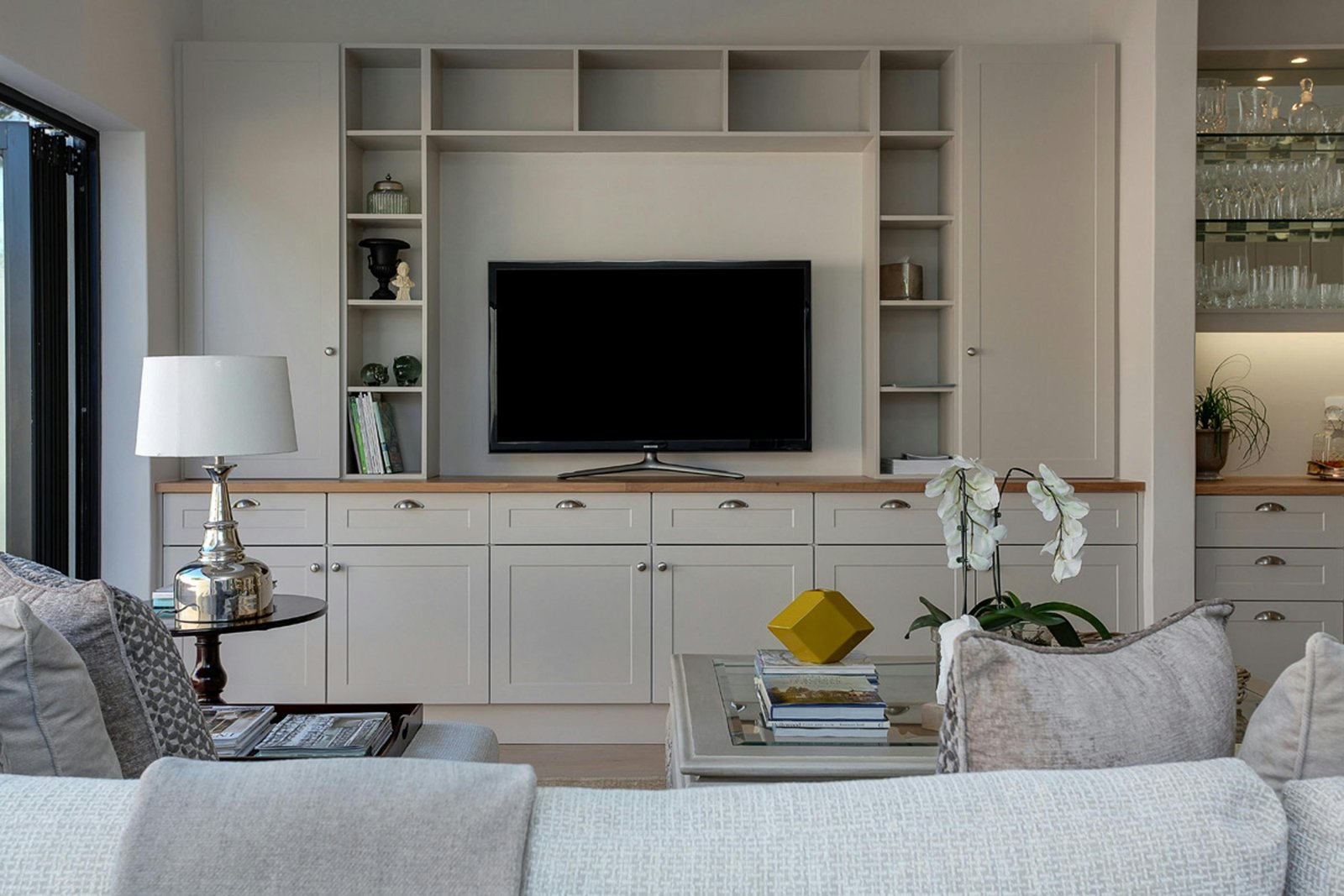
How long does it take to respray kitchen cabinets?
A typical on-site kitchen cabinet respray runs 3–5 working days for small-to-medium kitchens and 5–7 days for larger ones (25+ doors). The work is done in your home with full containment — no doors are removed to a workshop. A typical 5-day schedule:
- Day 1 — protect & prep: worktops, appliances and floors protected. Hardware removed. Cabinets degreased with alkaline cleaner and deep cleaned.
- Day 2 — sanding & repairs: surfaces keyed and sanded by hand, chips and opened joints filled.
- Day 3 — prime & set: adhesion primer (Zinsser BIN shellac on grease-prone surfaces), left to cure properly, then sanded smooth.
- Day 4 — first topcoat: first full coat of Tikkurila Helmi 30 or Dulux Diamond Satinwood, respecting cure time before the next stage.
- Day 5 — final coat & reinstate: second topcoat, snag check, hardware refitted, kitchen handed back clean.
You’ll have limited use of the kitchen for most of the week. For full details and worked examples see our kitchen cabinet painting service.
Wallpapering and freshly plastered walls
How long does wallpapering take?
A feature wall is usually a 1-day job including prep and lining. A standard room with lining paper and finish paper runs 2–3 days. Heavily patterned papers add time because of the careful drop matching at each seam — particularly large-repeat designs from suppliers like Sanderson or Cole & Son. Murals and panoramic installations need extra dry-hang alignment time before paste goes on.
Lead times for ordering the paper also matter. Stock papers (Graham & Brown, Dulux) arrive in under a week. Specialist heritage papers can take 2–3 weeks. Custom murals are 3–6 weeks — we factor the lead time into your overall schedule. See our wallpapering service for more.
How long after plastering can you paint?
Fresh plaster needs 2–4 weeks to dry fully before a finished paint job. Longer in winter, longer on thicker coats. The first coat is always a watered-down “mist coat” (typically 70% emulsion to 30% water) which seals the plaster and is absorbed into the surface — you do not start with a normal full coat. The plaster is ready when it’s uniformly pale (not patchy dark) and dry to touch across the wall.
If you’re combining plastering and painting, see our plastering service — we can quote both trades as one project with the drying window factored into the timeline.
What actually changes the timeline?
These are the variables that genuinely add or remove days — in roughly the order they matter most:
- Wall condition: sound, recently painted walls need minimal prep. Patchy walls with cracks, old wallpaper, blown plaster or stains need filling, sanding and stain-blocking primers. Prep can swing a project by 1–3 days.
- Number of coats: two coats is standard. Going from a dark colour to a pale one usually needs a third coat or a tinted primer. Each extra coat adds a day for drying.
- Ceiling work included: ceilings double the surface area per room. If you’re skipping the ceiling, expect to save 1–2 days on a whole-house project.
- Detailed woodwork: picture rails, dado rails, mouldings, panelled doors, banister spindles — all slow because they need careful cutting-in or full sand-and-recoat.
- Crew size: two painters work nearly twice as fast as one (one can prep while the other cuts in). A third crew member rarely halves the timeline because there’s only so much working space in most rooms.
- Furniture and access: a stuffed bedroom takes longer than an empty one. If you can move furniture to a single room before we start, the rest of the house finishes faster.
- Drying conditions: cold rooms, damp weather and humid air all extend cure times between coats. In summer with good ventilation, you can recoat within hours. In winter with the heating on, allow longer.
UK weather and seasonality — when timing actually matters
Interior painting is a year-round job — we work right through the calendar. Exterior is a different story.
- March – October: the working window for most exterior masonry paints. Temperatures stay above 8°C overnight and surfaces cure properly.
- April – September: the sweet spot — warm, dry, predictable. Bookings get tight from May onwards.
- November – February: exterior work pauses unless using cold-tolerant specialist systems. Quotes accepted in winter slot into a priority queue for the next season’s start.
For interior projects, the only real seasonal consideration is drying time. Rooms heated to a normal temperature with the windows cracked for ventilation cure paint within the published times — cold, unheated rooms in January take longer between coats.
FAQ
How long does it take to paint a small bedroom?
1–2 days for a standard small bedroom in reasonable condition. Includes furniture covering, dust-sheet prep, filling minor cracks, two coats on walls, and one to two coats on trim and ceiling.
How long does it take to paint a whole 3-bedroom house?
5–10 working days for a complete interior repaint of a typical UK 3-bed. Some rooms can be released back to you as they finish, so you’re rarely without a working bedroom or kitchen for the full project.
Can I stay in the house while you paint?
Yes — we plan whole-house projects room-by-room precisely so you can stay in residence. Furniture is moved to the centre of each room and covered. Bedrooms and kitchens are scheduled so you’re never without both at once.
How long do I need to wait between coats?
Modern water-based emulsions are touch-dry in 1–2 hours and can be re-coated after 4–6 hours under normal conditions. Trade satinwood and eggshell need a full overnight cure between coats. Cold, damp or unventilated rooms extend these times.
Can painting be done faster than the timings above?
Yes — but usually by skipping prep, applying only one coat, or pushing fresh paint through cure time it hasn’t had. We don’t do any of those things. If your timeline is tight, the right answer is usually a second crew, not a faster crew.
How long does it take to get a written quote?
We aim to come back within 24 hours of a site visit for residential jobs, and 48 hours for larger commercial or multi-property quotes. Tell us the rough scope and we’ll book the visit and confirm the turnaround.
How long does it take to paint a house exterior in the UK?
5–8 working days for a typical terraced or semi-detached exterior, with weather days built in. Larger detached homes or scaffolded gable-end work runs 10–12 days. The biggest variable is British weather — we reschedule rain-risky days rather than rush a finish.
What if you find unexpected damage during prep?
We tell you straight away, with photos and a written variation. Common discoveries include blown render under old paint, water-damaged plaster behind wallpaper, or rotten timber under gloss. We quote the remediation separately so you can decide before the cost is in the wall.